Chapter 13
Driving Licence, Documents, Insurance & Technical Requirements
The two provisional licence models, the accompanying driver, the L sign, restrictions during the learning period, documents you must be able to produce, compulsory insurance, and the roadworthiness inspection.
What a category B licence covers
A category B licence — provisional or full — covers vehicles with a maximum authorised mass (MAM, sometimes abbreviated MTM) of up to 3.5 tonnes: a car, a car for double use (part passenger, part cargo), a minibus, or a light truck. Almost everything taught in these lessons is written with this weight class in mind.
The provisional licence: two models
Belgium offers two paths to a category B (car) licence. The 36-month model, open from age 17, requires a registered accompanying driver in the car at all times. The 18-month model, open from age 18, requires no accompanying driver, but only after completing at least 20 hours of practical lessons at a recognised driving school and earning a competency certificate. You may switch between the two models once.
The accompanying driver
- Must have held a category B licence for at least 8 years.
- Must not have been disqualified from driving in the last 3 years.
- Must be registered on the provisional licence itself — up to two accompanying drivers may be listed.
The 'L' sign
A car driven on a provisional licence, under either model, must display a clearly visible 'L' sign at the rear for as long as the provisional period lasts.
The 'L' sign must stay clearly visible at the rear of the car for the whole provisional period.
Restrictions during the provisional period
- The same general 0.5 g/l alcohol limit applies as for any other driver — there is no special lower limit for provisional or novice drivers — but the penalties for exceeding it are harsher: a mandatory driving ban of at least 8 days and mandatory re-sitting of the theory and practical exams.
- Driving is not allowed between 22:00 and 06:00 on Fridays, Saturdays, Sundays, and the eve or day of a public holiday.
- Towing a trailer, and transporting goods commercially, are not allowed during the provisional period.
- On a motorway, speed is capped at 90 km/h even where the posted limit is higher (see Chapter 11).
Documents you must be able to produce
- Your valid driving licence.
- The vehicle's registration certificate.
- Proof of insurance — since 2022 this is a white certificate (paper or digital), replacing the older two-sided green card.
- The roadworthiness inspection certificate, when the vehicle is old enough to require one.
- Your identity card — everyone over 15 must be able to show one, drivers included.
Compulsory insurance
Every vehicle driven on a public road must be covered by third-party liability insurance. This is a minimum: it compensates injury or damage you cause to others — other road users, their vehicles, or property — not damage to your own vehicle. Cover for your own vehicle is a separate, optional choice.
The roadworthiness inspection
A car needs its first roadworthiness inspection at 4 years old. After that, inspections were traditionally annual, but a newer rule allows a 2-year interval for younger, lower-mileage cars, reverting to annual once the vehicle passes the relevant age or mileage threshold. A vehicle inspected for a change of ownership carries a certificate valid for one year regardless.
Driving without a licence, insurance, or valid inspection
Driving without a valid licence, without insurance, or without a valid roadworthiness certificate are all treated as serious offences, prosecuted before the police court rather than handled as a routine ticket — the possible consequences include a driving ban and, for uninsured driving, even imprisonment. If you cause an accident while uninsured or without a valid inspection, the cost of the damage can fall back on you personally.
M.A.W. and M.G.W.: two different weights
Think of the Maximum Authorised Weight (M.A.W., also seen written as MAM or MTM) as a ceiling the manufacturer sets once and for all: the heaviest the car, its fuel, everyone riding in it, and everything it's carrying are allowed to add up to before the vehicle is being pushed past what it was built to handle safely. That number is fixed for the life of the car. The Maximum Gross Weight (M.G.W.), by contrast, is whatever the car actually weighs at a given moment — put it on a scale right now, empty vehicle plus fuel plus passengers plus today's cargo, and that reading is the M.G.W. It shifts from one trip to the next depending on what you're carrying, but it can never legally climb above the M.A.W.; once it does, the vehicle has become overloaded and no longer satisfies its safety rating.
M.A.W. — fixed by the manufacturer, never changes
M.G.W. within limit — allowed
M.G.W. over the limit — overloaded
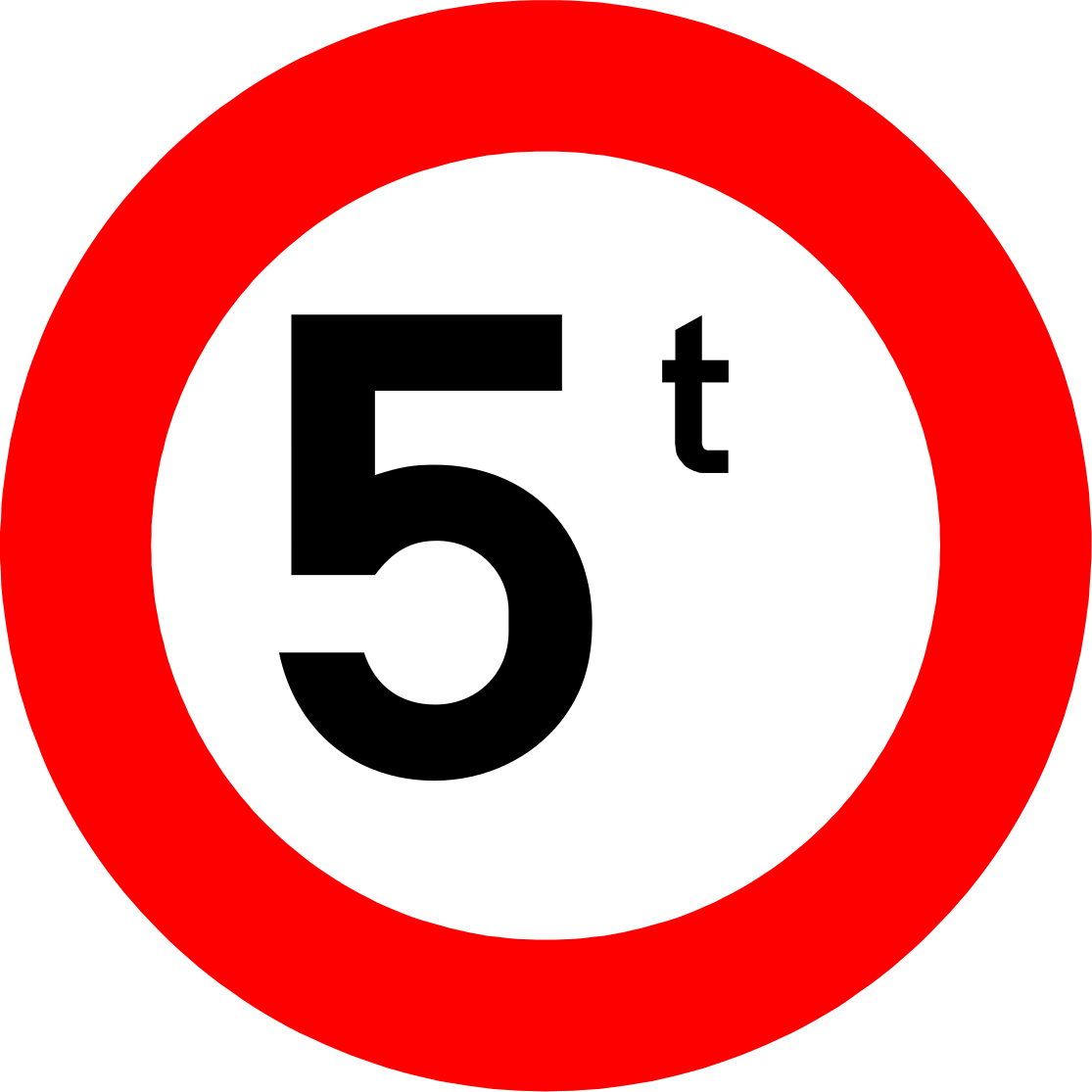
C21 — no entry for vehicles whose actual (gross) weight exceeds the value shown (here, 5 tonnes)

E9a — parking allowed (a sub-plate can restrict this to vehicles above a given M.A.W., such as '> 3.5 t')

C31a — no left turn at the next junction

C31b — no right turn at the next junction
Like the other prohibitive signs, C31a and C31b can carry a sub-plate limiting the turn ban to vehicles above a given M.G.W. — so read the sub-plate carefully before assuming a turn restriction applies to your car.

C33 — no U-turn, from this sign up to and including the next junction
C33 bans a U-turn for the entire stretch from the sign up to and including the next junction — not just at one specific spot. Like C31a and C31b, it can carry a sub-plate that limits the ban to vehicles above a given M.G.W.

C39 — from this sign to the next junction, goods vehicles (or combinations) with an M.A.W. over 3.5 tonnes may not overtake a vehicle with more than two wheels, or one drawn by animals, on the left

C41 — end of the restriction imposed by C39
Mandatory equipment in the car
Four items are non-negotiable in every car: a red warning triangle, a first aid kit, a fire extinguisher, and a reflective safety jacket. Plenty of other gear rides along in most cars without actually being required by law — a tow cable, a spare wheel, a jack, a parking disk, a GPS unit, a hands-free phone kit — genuinely handy, just not compulsory.
Carrying a load safely
Whatever you load onto or into a car, it must never endanger other road users, damage other vehicles or property, block your view, or drag along or fall onto the road.

C29 — no entry for vehicles that, load included, exceed the height shown

C27 — no entry for vehicles that, load included, exceed the width shown

C25 — no entry for vehicles or combinations that, load included, exceed the length shown
A car and its load together may be at most 4 metres tall and 2.55 metres wide before it counts as exceptional transport — bridges and tunnels can also impose a lower height limit with sign C29. Nothing may project beyond the front of the car at all; watch for this when carrying a ladder on a roof carrier. At the rear, a load may project up to 1 metre without any special marking, but must never cover the lights.
Dangerous goods

C24a — no entry for vehicles transporting dangerous goods

C24b — no entry for vehicles transporting dangerous flammable or explosive goods

C24c — no entry for vehicles transporting goods that could contaminate water
These three signs ban vehicles based on what they are transporting, not what fuels them — so a car that itself runs on LPG is not banned by C24b, since the sign targets the cargo, not the vehicle's own fuel tank.
Towing a trailer with a full licence
Under neither provisional model may you tow a trailer at all. Once you hold the definitive category B licence, trailers up to 750 kg come with no strings attached. Go heavier than that — 900 kg, for instance — and category B still covers you, provided the car and trailer's combined M.A.W. doesn't push past 3.5 tonnes.
Car sharing
Car sharing swaps individual ownership for occasional access: a pool of people book the same vehicle through a reservation system for whatever slot they need, rather than each buying a car of their own — and it's a different arrangement from carpooling, where people simply ride together toward a shared destination. In Belgium, Cambio is the name most associated with the idea: a fleet the operator itself owns and stations at fixed spots in city after city, available to members who've generally held a category B licence for three years or more.
Chapter quiz
Check what you remember. Questions and answer order are shuffled every attempt, and you'll have 20 seconds to answer each one.