Chapter 11
Motorways & Special Roads
Motorway speed limits, who is banned from using a motorway, safely joining and leaving, overtaking and lane rules, what to do if you break down, actions that are always forbidden, and the separate 'autoweg' road category.
Speed on a motorway
Top speed tops out at 120 km/h. The right-hand lane also carries a floor of 70 km/h, waived only when a sign posts something lower or when traffic, weather, or roadworks make it genuinely impossible to keep up. A 90 km/h ceiling applies to anything over 3.5 tonnes and to most buses. Drivers still on a provisional licence are welcome on the motorway too, just held to that same 90 km/h ceiling regardless of what the posted limit says.
Who may not use a motorway
- Pedestrians and cyclists.
- Moped riders, of any class.
- Horse riders and anyone leading an animal, and agricultural vehicles.
- Any vehicle that cannot sustain at least 70 km/h.
Joining a motorway
Legally speaking, merging onto the motorway through the acceleration lane is treated as nothing more than a lane change — which puts the obligation squarely on you, the merging driver, to give way to traffic already flowing on the carriageway. Use that acceleration lane to get your speed up and thread into a gap yourself, rather than banking on through traffic making room.
Joining a motorway is a lane change — the merging driver must give way to traffic already on the carriageway.
Leaving a motorway
Signal and move into the deceleration lane in good time, and do your slowing down inside that lane — not on the main carriageway, where a sudden drop in speed endangers traffic behind you. Only leave at a marked exit.
Overtaking and lane use
As on any road, you overtake on the left. Undertaking on the right remains forbidden, with the same practical exceptions as elsewhere: briefly, while still on an acceleration lane, or in slow-moving congestion where several lanes are crawling at similar speeds. The hard shoulder is never a driving lane — it is reserved for breakdowns, genuine emergencies, and vehicles directed there by the police.
Lane-specific and temporary speed limits
A sign can set a different speed limit for different lanes — for example, 90 km/h on the two left lanes and 70 km/h on the right lane, often repeated roughly 1500 metres in advance. At some exits, a combined sign sets a separate, usually lower, speed limit just for the exit ramp itself.
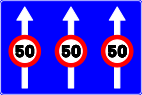
F91 — 90 km/h on the two left lanes, 70 km/h on the right lane
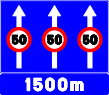
F89 — advance warning of the same limits, about 1500 m ahead

C43 (90) with a panel below it — a speed limit that applies only to the exit ramp

GXI — the sub-panel used to mark that limit as applying to the exit only
Windless spells let heavy traffic accumulate into smog — fine airborne particles that are genuinely bad for people's health. To keep that from getting worse, authorities can impose a temporary 90 km/h cap on motorways for a day or several in a row, flagged either through electronic signage overhead or an ordinary 90 km/h sign carrying a 'SMOG' plate beneath it.
The rush-hour lane
Certain stretches of motorway can bring an extra lane online during the busiest hours purely to keep congestion from building up, set apart from the regular lanes by a dashed white line. What tells you whether it's open is the sign hanging above it: a red X rules it out for you, a green arrow clears you to use it. Since this strip tends to run narrower than the lanes beside it, expect a reduced speed limit posted overhead as well. Should your car give out while you're on it, resist stopping right there — push on, if you're able to, until you reach a proper refuge bay.
Forming a rescue lane
The instant a jam starts building on a road with two or more unbroken lanes running your way — this rule isn't motorway-specific — drivers owe emergency crews a corridor before the traffic column actually seizes up completely. Two lanes means that gap sits between left and right; add a third lane and it shifts to sit between left and centre instead. Nobody forming that gap from the right-hand lane is allowed to duck into a rush-hour lane that's currently shut, onto the hard shoulder, into a bus lane, or onto pavement reserved for buses.
Wrong-way drivers
Every so often, someone ends up pointed the wrong way on a motorway, meeting oncoming traffic head-on where the carriageway is supposed to run one direction only. Should you ever spot one coming toward you: drop your speed and tuck into the right-hand lane — accident data consistently shows these drivers gravitate toward what feels like 'their' right, which from your seat is the left lane. Save any headlight flash for the exact instant your paths actually cross, never sooner, so you don't send them into a panicked reaction. Once you're somewhere safe, phone it in to the police.
If you break down
Get your hazard lights blinking right away, and pull onto the hard shoulder if the car's still driveable. Before anyone opens a door, the driver needs that reflective safety vest on — the reason it lives in the cabin rather than the boot is exactly this scenario. That obligation follows you onto both motorways and the 'autoweg' category, in fact anywhere you've landed somewhere stopping or parking would normally be off-limits. Set the warning triangle down roughly 100 metres back from the car — a full 70 metres further than the 30-metre mark you'd use on an ordinary road — positioned so oncoming drivers can still spot it from 50 metres out. Then move everyone behind the crash barrier, clear of both the carriageway and the shoulder, and dial for help: 112 is the pan-European emergency line and connects you anywhere within Belgium or the wider EU.
Pull onto the hard shoulder, put on a hi-vis vest before getting out, place the triangle about 100 m behind, and wait behind the barrier.
Actions that are always forbidden on a motorway
- Backing up, or turning around via a U-turn or a three-point maneuver.
- Cutting across the central reservation, or heading against the normal direction of travel.
- Halting or parking on the carriageway or the hard shoulder, except for an actual breakdown or emergency.
- Using a cross-link that joins the two carriageways, or straying onto the verge.
- Hauling a disabled vehicle by means of an emergency tow clutch or link.
"Special roads" — the autoweg
Signs F9 and F11 bookend a category of road set aside for motor vehicles that falls short of a full motorway — the 'autoweg'. Level junctions and working traffic lights can still show up on it, and it turns away the same crowd a motorway does (no pedestrians, cyclists, mopeds, or slow-moving vehicles), yet the 70 km/h floor disappears entirely; whatever speed limit happens to be posted is simply the one that governs.

F5 — start of a motorway

F7 — end of a motorway

F9 — start of a road reserved for motor vehicles

F11 — end of a road reserved for motor vehicles
Blue-and-white information signs also carry road numbers, so you can tell at a glance what kind of route you are on.

F23c — number of an international (E-) road

F23d — number of a Belgian motorway (A-)
Chapter quiz
Check what you remember. Questions and answer order are shuffled every attempt, and you'll have 20 seconds to answer each one.