Chapter 10
Stopping & Parking
The legal difference between stopping and parking, where both are forbidden, where only parking is forbidden, how to position your vehicle correctly, the blue zone and parking disc, and opening your door safely.
"Stopping" vs. "parking" — why the difference matters
The legal test for 'stopping' comes down to duration and purpose: your vehicle has to be immobile no longer than it genuinely takes for a passenger to climb in or out, or for cargo to be loaded or unloaded. Go past that point and the law now calls it parking, whether or not you've stepped out from behind the wheel. No clock defines the cutoff in minutes — it's simply however long the underlying task honestly requires.
Where stopping and parking are both forbidden
- Within 5 metres of a crossing used by pedestrians or cyclists, and within 5 metres of the point where a cycle track begins or ends.
- Directly on a level crossing.
- On tram rails embedded in the carriageway.
- On any raised road feature — a speed hump or a raised junction table, for instance.
- Within 5 metres of a junction, that distance measured out from where the near edge of the crossing road would extend.
- Within 20 metres ahead of traffic lights, junction or no junction — the sole exception being a vehicle standing no taller than 1.65 m where the light itself is mounted at least 2 m above the roadway.
- Inside a tunnel, beneath a bridge, mid-bend, or just past the crest of a hill — anywhere sightlines run short.
- On a cycle track, or on a pavement set aside for people on foot.
- Anywhere it would pinch the free passage on the roadway to under 3 metres, or directly across from another halted or parked vehicle if the pair of them would stop two vehicles from passing each other.
- Beside a vehicle that's already parked at the kerb — in other words, double parking.
Within 5 m of a junction
Within 20 m before traffic lights
Where only parking is forbidden — brief stopping is still allowed
In a shorter list of places, you may stop briefly to drop someone off or load and unload, but you may not leave your vehicle there.
- Within 15 metres either side of a sign marking a bus, trolleybus, or tram stop.
- Blocking a private driveway or garage entrance — the sole exception being the owner, provided their own number plate is clearly posted right on the entrance or gate.
- Wherever it would choke off access to an off-street parking area, or stop vehicles already inside from getting back out.
- Wherever your vehicle, acting as an obstacle, would push cyclists, moped riders, or pedestrians off a cycle track or pavement and out into the carriageway.
- Closer than 1 metre to another stopped or parked vehicle.
- In a bay set aside for disabled-badge holders, unless you're carrying that badge yourself.
More places where parking specifically is forbidden
- On the carriageway of a priority road (B9) once you're outside a built-up area — inside one, it's permitted.
- On a carriageway that's been split into lanes by road markings, unless a sign specifically grants an exception at that spot.
- In the centre lane of a three-lane road.
- Along the left-hand side of a road that has two separate carriageways, once you're outside a built-up area. Inside one, left-side parking becomes possible wherever a level verge separates the two carriageways — but only if you actually park on that verge.
- Next to a broken yellow line running along the edge of the carriageway.

E5 — parking prohibited on this side from the 1st to the 15th of the month

E7 — parking prohibited on this side from the 16th to the end of the month
Reading the arrows under a parking sign
A tiny arrow plate fixed beneath an E1, E3, E5, or E7 sign pins down exactly where its restriction takes hold. Left unadorned, the sign's reach simply runs from its post to the next junction. Add an arrow tipped upward and the restriction is pushed to begin only past the sign; tip it downward and the restriction instead stops right there, having applied up to that point; give it arrows both ways and the restriction covers the stretch on both sides of the sign.
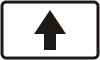
Xa — arrow up: the restriction above it starts here and continues beyond this point

Xb — arrow down: the restriction above it ends at this point
Starts beyond the sign
Ends at the sign
Applies on both sides
Temporary bans with a date and time window
A portable version of the E1/E3 sign — mounted on a weighted base rather than a fixed pole — is commonly put out for house moves, road works, or events. Below the pictogram it adds a blue panel stating exactly when the ban is active: a date range (from which day to which day) and, often, an hour range within those days. The ban, and any risk of being towed, only applies during that exact window. Before it starts or after it ends, the normal parking rules for that street resume, even though the sign is still standing there.
Movers, road works, and events often reserve a stretch of curb with a portable sign like this. The dates and hours are what actually matter — outside that exact window, normal parking rules on that street apply again.
Positioning your vehicle correctly
Whenever you stop or park, keep the vehicle parallel to the kerb, on the right in whichever direction you're heading, tucked as tight as reasonably possible against the edge of the carriageway, and lined up in a single row — never sitting out from the kerb in a second row. A one-way street relaxes that rule, letting you choose either side. If a usable verge runs alongside, that's where you're required to park rather than out on the carriageway: inside a built-up area, only a verge flush with the ground qualifies, but once you're outside one, either a flush or a raised verge will do. Straddling the verge and the road is fine too, provided you still leave a walkable 1.5-metre strip wherever that verge doubles as a footpath. The carriageway itself only becomes an option when no usable verge exists at all. And wherever a thick unbroken white line runs along the carriageway's right edge, everything beyond it is a marked pocket where you're free to stop or park.
The blue zone and the parking disc
A zone marked for limited-duration parking — better known as a 'blue zone' — requires drivers of cars and similar vehicles to display a parking disc against the inside of the windscreen, set to show when you arrived. The default schedule, unless a local sign overrides it, runs Monday through Saturday, 09:00 to 18:00, capping your stay at 2 hours. Motorcycles and mopeds don't need one. Plenty of ordinary parking signs outside any blue zone carry their own sub-panel demanding a disc too, so the requirement isn't confined to zones alone.

E9e — where you park, it must be on the verge or pavement only

E9f — where you park, it must be partly on the carriageway and partly on the verge

E9g — where you park, it must be on the carriageway only

E1 — parking prohibited (stopping still allowed)

E3 — stopping and parking both prohibited

E9a — parking permitted (may carry a sub-panel: disc required, disabled only, EV charging)
Getting in and out of a parked car
- Before you step out: set the handbrake, roll up every window and close any open roof, kill the engine, and pull the key from the ignition.
- Swing yourself out toward the rear of the car, and shut the door the moment you're clear of it — that way you end up facing traffic coming from behind instead of presenting it your back.
- Getting back in works the same way in reverse: approach from the front of the car, again so you stay facing whatever traffic is arriving from behind.
Time limits on public roads
- A defective vehicle can sit on a public road for no more than 24 hours.
- A vehicle whose sole purpose is advertising gets a much tighter cap of 3 hours.
- Using a public road as a showroom to sell a vehicle isn't allowed under any circumstance.
Opening your door safely
Before opening a door, getting out, or leaving a door open, you must make sure this creates no danger or unnecessary hindrance to other road users — checking your mirrors and blind spot for an approaching cyclist is especially important, since a door opened into their path is a common and serious cause of injury.
Chapter quiz
Check what you remember. Questions and answer order are shuffled every attempt, and you'll have 20 seconds to answer each one.