Chapter 9
Public Transport, Trams & Level Crossings
Why trams always have priority, how to pass a stopped tram or bus safely, letting a bus pull away from a stop, the rules for approaching and crossing a level crossing, and never blocking a junction or crossing.
Trams always have priority
A tram outranks everyone: whichever direction it's coming from — left included, in situations that would normally hand priority to the right — every other road user has to yield. Standing on or beside the rails means clearing out without delay. Only three things can override that absolute standing: an active traffic light, a person with authority actively directing traffic, or a posted priority sign.
Tram rails don't only show up at level crossings — plenty of ordinary streets have them laid straight into the road surface. Roughly 150 metres before one of these crossings, the A49 sign gives you advance notice that your road is about to cut across one or more embedded tram tracks, so stay alert for a tram, since its priority there is just as absolute as anywhere else.
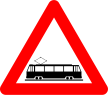
A49 — tram crossing ahead (about 150 m)
Passing a stopped tram or bus
Slow down every time you pass a bus, tram, or similar vehicle that's paused to load or unload passengers. Where the stop lacks a safety island, slowing isn't enough — bring your car to a full stop on whichever side people are getting on or off, and don't move again above a moderate pace until everyone involved has safely made it to either the pavement or the vehicle.
No safety island at the stop — wait behind until every passenger has safely reached the pavement or the tram.
Letting a bus pull away from a stop
Find yourself behind a bus inside a built-up area just as it signals to leave its stop, and the obligation falls on you: ease off and, if needed, come to a stop so it can rejoin the traffic flow. The bus driver, for their part, owes you no right of way here.
Approaching a level crossing
Always approach a level crossing with extra caution. If it has no barriers or lights, or if the lights are not working, you may only cross once you are certain no train is approaching.
- You must not enter a level crossing while the barriers are moving down or closed.
- You must not enter while the red lights are flashing or the audible warning is sounding — this applies to everyone, including pedestrians, not just vehicles.
- You must not enter if traffic congestion beyond the crossing would likely force you to stop on the tracks.
Barriers lowering or red lights flashing — stop. Never enter, overtake, or wait on the crossing itself.
Stopping and overtaking near a crossing
Stopping or parking on a level crossing itself is always forbidden, without exception. Overtaking on the left is also forbidden when approaching a crossing marked with the St. Andrew's cross sign, unless that crossing has barriers, or has traffic lights that are actually showing the white 'proceed' light. This overtaking ban applies to animals in harness, vehicles with more than two wheels, and two-wheeled motor vehicles — a cyclist falls into none of those, so you may always overtake a cyclist near a level crossing.
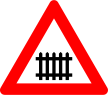
A41 — advance warning: crossing with barriers ahead
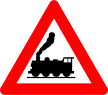
A43 — advance warning: crossing without barriers ahead

A45 — St. Andrew's cross at the crossing, single track
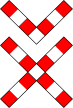
A47 — St. Andrew's cross at the crossing, two or more tracks
Never block a junction, crossing, or lane
Even when the traffic light ahead is green, you must not enter a junction or a level crossing if congestion means you would likely have to stop in the middle of it, blocking the path of cross traffic, a tram, or a bus lane.
At a busy junction where tram tracks run through it, this rule is often painted right onto the road: a criss-cross hatched box over the tracks, sometimes with the word 'TRAM' inside it, framed by pedestrian crossings on either side. It is not a separate rule — it is the same never-block principle, made visible exactly where blocking a tram would cause the most trouble. Treat it like a box junction: check that the far side is actually clear before you enter, and if a queue ahead would trap you on the hatching, stop short of it and wait, even with a green light.
Wrong — stopped on the hatched marking, blocking the tram
Right — waiting behind the marking until the tracks are clear
A criss-cross hatched box painted over tram tracks — sometimes labelled 'TRAM' — works like the never-block rule you already know: even on a green light, only enter if you can see all the way through. If a queue ahead would trap you on the tracks, stop before the hatching and let the tram (and cross traffic) through first.
Chapter quiz
Check what you remember. Questions and answer order are shuffled every attempt, and you'll have 20 seconds to answer each one.