Chapter 8
Pedestrians, Cyclists & Other Vulnerable Road Users
Priority at pedestrian crossings, the no-parking zone in front of a crossing, the minimum overtaking distance for cyclists and moped riders, how cyclists may ride side by side, the B22 and B23 signs, and other vulnerable road users.
Priority at pedestrian crossings
At a marked pedestrian crossing without traffic lights or a police officer, you must give way to any pedestrian who is already on the crossing or clearly about to step onto it. This applies even if you are turning at a junction and have a green light — pedestrians already crossing or entering the road you are turning into keep priority over you.
Give way to a pedestrian on or about to step onto the crossing
No stopping or parking within 5 m of the crossing
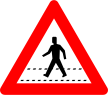
A21 — warning sign, placed about 150 metres before a pedestrian crossing

F49 — information sign, placed at the pedestrian crossing itself
A pedestrian crossing sometimes has 'wings' too — angled markings that flare the crossing wider at each end, making it stand out more clearly, especially to a lorry driver sitting high above the road. Pedestrians carry a matching obligation: wherever a marked crossing lies within 20 metres, they must walk to it instead of stepping into the road elsewhere; only where nothing suitable exists nearby may they cross at another point, and there they must yield to traffic already on the road.
Who counts as a pedestrian
The traffic code defines a 'road user' as anyone who is out on the public road — pedestrians together with everyone driving a vehicle. Animals, whether a cat or a stray cow, and objects, such as an unattended bicycle leaning against a wall, don't count as road users on their own. A pedestrian is defined as a person travelling on foot, expected to keep to the pavement, footpath, or verge wherever one is available; if none is present, the cycle track is the next choice, with the carriageway itself only as a last resort.
Legally, 'pedestrian' covers more than a person strolling with empty hands. Anyone guiding along a wheelbarrow, a shopping trolley, a wheelchair, or another non-motorised contrivance at walking pace falls under the same label — and so does someone walking a bicycle or moped that has broken down. A car or a motorbike is treated differently, though: push it as much as you like, it remains a vehicle, not a pedestrian's load.
Pedestrian zones
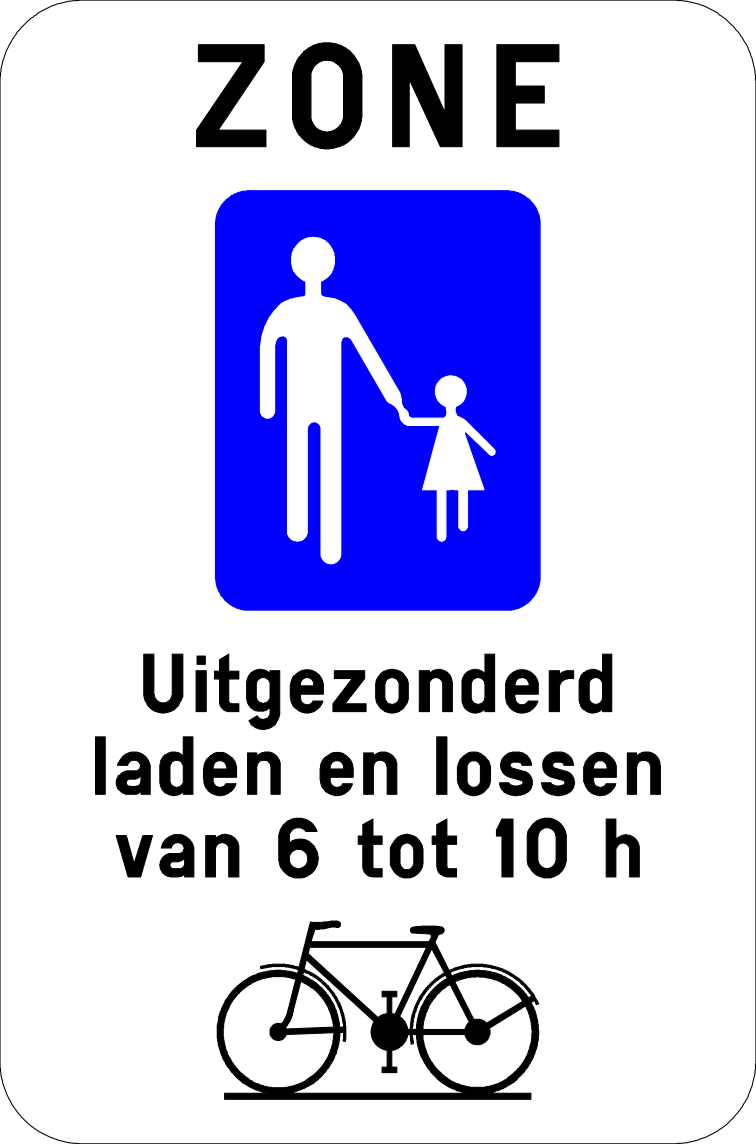
F103 — start of a pedestrian zone
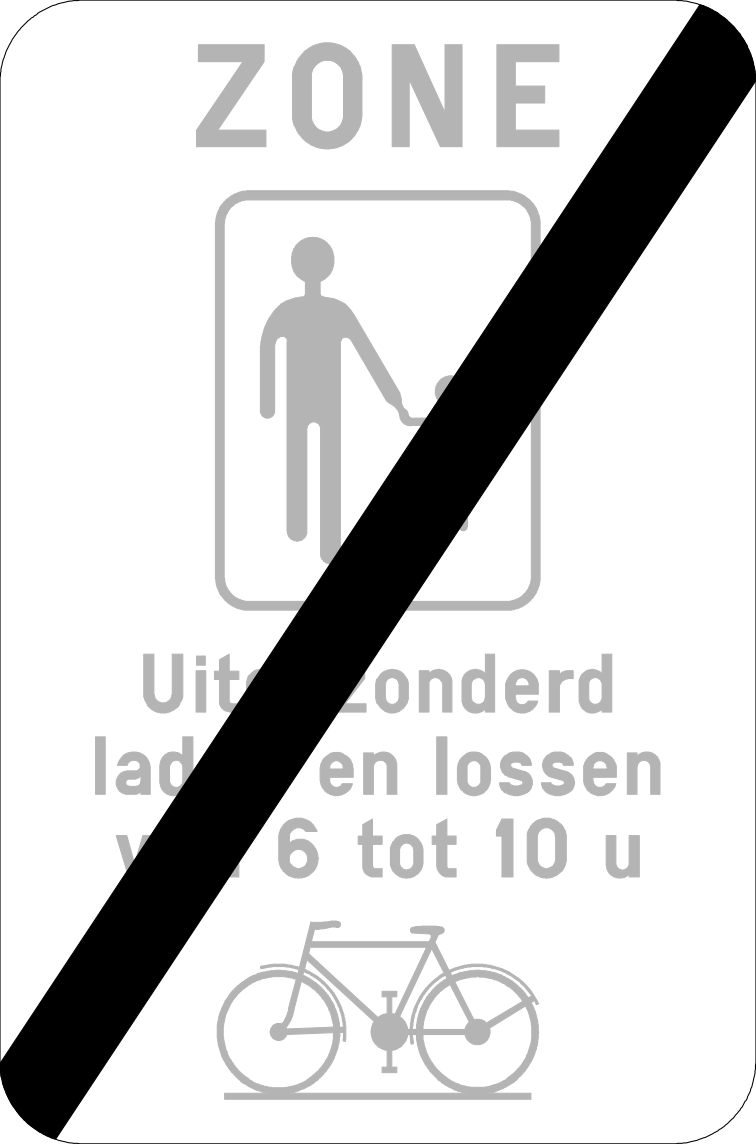
F105 — end of a pedestrian zone
A driver exceptionally admitted to a pedestrian zone — a resident, say, or a delivery van within its permitted window — is bound by three requirements: keep the pace to a crawl, keep a path open for anyone on foot and be ready to stop, and under no circumstances get in a pedestrian's way.

C19 — no entry for pedestrians
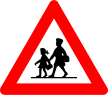
A23 — warning sign: children present
Who counts as a driver
The traffic code's definition of a driver is anyone operating a vehicle, whether or not it has an engine. Push a car or a motorcycle along and you're still classed as its driver — quite unlike pushing a bicycle or moped, which makes you a pedestrian instead. That still leaves three obligations in place: the correct licence has to be carried, a helmet worn if it's a motorcycle being pushed, and the carriageway used instead of the pavement.
The category also stretches to anyone on the public road who is accompanying or watching over draft animals, farm animals, or horses — someone leading cattle toward a field, a person on horseback, an escort riding alongside a young horse rider, or the driver of a horse-drawn cart all count as drivers in this sense. And a quick note on the wording used from here on: 'road users' covers pedestrians plus the drivers of every kind of vehicle, motorised or not, whereas 'drivers' by itself leaves pedestrians out.

C7 — no entry for motorcycles

C9 — no entry for mopeds

C22 — no entry for buses

C23 — no entry for goods vehicles

C13 — no entry for animals in harness

C5 — no entry for motor vehicles with more than two wheels, and motorcycles with a sidecar

C6 — no entry for quad bikes (open-bodied, four-wheeled, off-road vehicles with a motorcycle-style handlebar and saddle)
These prohibitive signs, together with C9, C11, and C19 seen earlier, each ban only the specific category of driver or road user shown in the pictogram — a sign is not automatically binding on every kind of driver, only the categories it actually depicts.
Overtaking a cyclist or moped rider safely
When you overtake a cyclist, speed pedelec, or moped rider, you must leave a minimum lateral distance of 1 metre in a built-up area and 1.5 metres outside a built-up area. If there is not enough room on the road to leave that gap, you must not overtake — stay behind until it is safe.
In a built-up area: at least 1 metre
Outside a built-up area: at least 1.5 metres
If there isn't enough room to leave this gap, you must not overtake — stay behind the cyclist.
Cycle tracks: what they are
A cycle track is that stretch of the public road set aside for bicycles and two-wheeled class A mopeds, whose speed is capped at 25 km/h. It sits outside the carriageway altogether, meaning a car has no business driving, waiting, or parking there. You'll recognise one either from the signs shown below, or from a pair of parallel broken white lines with no car traffic permitted between them.
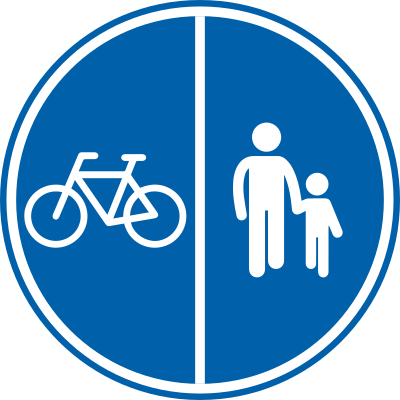
D9 — segregated path: pedestrians on one side, cyclists and moped class A on the other

D10 — shared path: pedestrians and cyclists together, mopeds not allowed

F99a — a path for pedestrians, cyclists, and riders together (the pictogram changes to match exactly which groups are allowed)

F101a — end of the road reserved for these categories
F99a marks the start of a road reserved for the specific categories of road users shown in its pictogram, and F101a — the same sign with a red diagonal line — marks its end. On this kind of reserved road, drivers must take extra care whenever children are present, and the speed limit is 30 km/h.

F99c — a concrete example of this pictogram: reserved for agricultural vehicles, pedestrians, cyclists, and riders
A small white panel below the D7 obligatory-cycle-track sign can add a rule for moped class B riders: one panel means they must also use the cycle track, another means they are specifically not allowed to. Where no cycle track exists at all, the prohibition sign C11 (a bicycle symbol in a red circle) can also ban cyclists from a road entirely.

C11 — no entry for cyclists
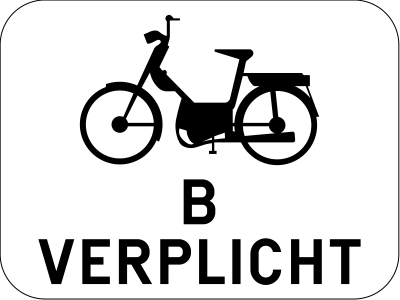
M6 — moped class B riders must also use this cycle track
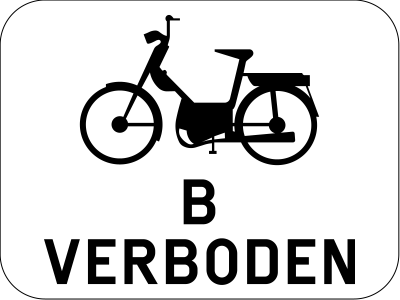
M7 — moped class B riders are not allowed on this cycle track
At the point where a cycle track runs out and its riders have to rejoin the carriageway, they take priority — it's the carriageway drivers who owe them right of way, not the other way round. That merge point also carries its own 5-metre buffer: no waiting or parking, on the road or the verge, within 5 metres either side of it.
Crossings for cyclists and moped riders
A crossing set aside specifically for cyclists and moped riders gets its own advance warning about 150 metres out via sign A25, with the blue F50 marking the crossing itself. The rule here runs opposite to a pedestrian crossing: it's the cyclists and moped riders who must yield to traffic already using the road — yet you're still required to slow to a moderate pace on approach so as not to put them at risk or block their way. Stopping and parking are off-limits at the crossing, on the verge next to it, and on the road for the 5 metres leading up to it.
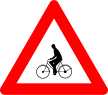
A25 — warning: a cyclist/moped crossing is about 150 m ahead

F50 — placed at the crossing itself
How cyclists are allowed to ride
- On a cycle track, cyclists may always ride two abreast — except when another cyclist or moped rider wants to overtake, or when a two-way cycle track is too narrow to let oncoming cyclists pass.
- Where there is no cycle track and cyclists follow the carriageway, they may also ride two abreast — except where it would prevent oncoming traffic from passing.
- Outside a built-up area, cyclists riding two abreast on the carriageway must move into single file as soon as a vehicle approaches from behind.
- A cyclist towing a trailer must ride in single file.
- Children up to and including 9 years old may always cycle on the pavement.
Cyclists riding in large groups
Take an organized touring group of 15 to 50 cyclists that rides together as a unit: it's under no obligation to use a cycle track and is free to ride two abreast on the carriageway the whole way, though restricted to the right-hand lane, or, where the road has no lane markings at all, to no more than half its width. A group of this size can be flanked by an accompanying car roughly 30 metres in front and another 30 metres behind; with just a single accompanying car, it takes up the rear position instead.
Scale that up to a group of 51 to 150, and the same priority rules still apply, but now escort cars stop being optional — one is required ahead of the group and another behind, and each has to display a recognisable blue sign, a general danger symbol paired with a white bicycle beneath it, positioned so both oncoming traffic and vehicles following can spot it without difficulty. Where the group reaches a junction with no traffic lights, a designated marshal is allowed to hold back crossing traffic long enough for the entire group — escort cars included — to get through.
Bike streets and bike zones
A bike street begins at the F111 sign and runs until the F113 sign appears — or, absent that, until the next junction. Inside it, the cyclist ranks above every other road user, notwithstanding that motor vehicles remain free to enter; what they can't do is pass a cyclist while inside its boundaries, and 30 km/h is the ceiling. Technically, a royal decree dated 12 March 2023 swapped this concept out in favour of the 'bike zone' described next, but a 9-year grace period keeps every bike street already in place — and the rule itself — fully valid and still fair game on the exam.
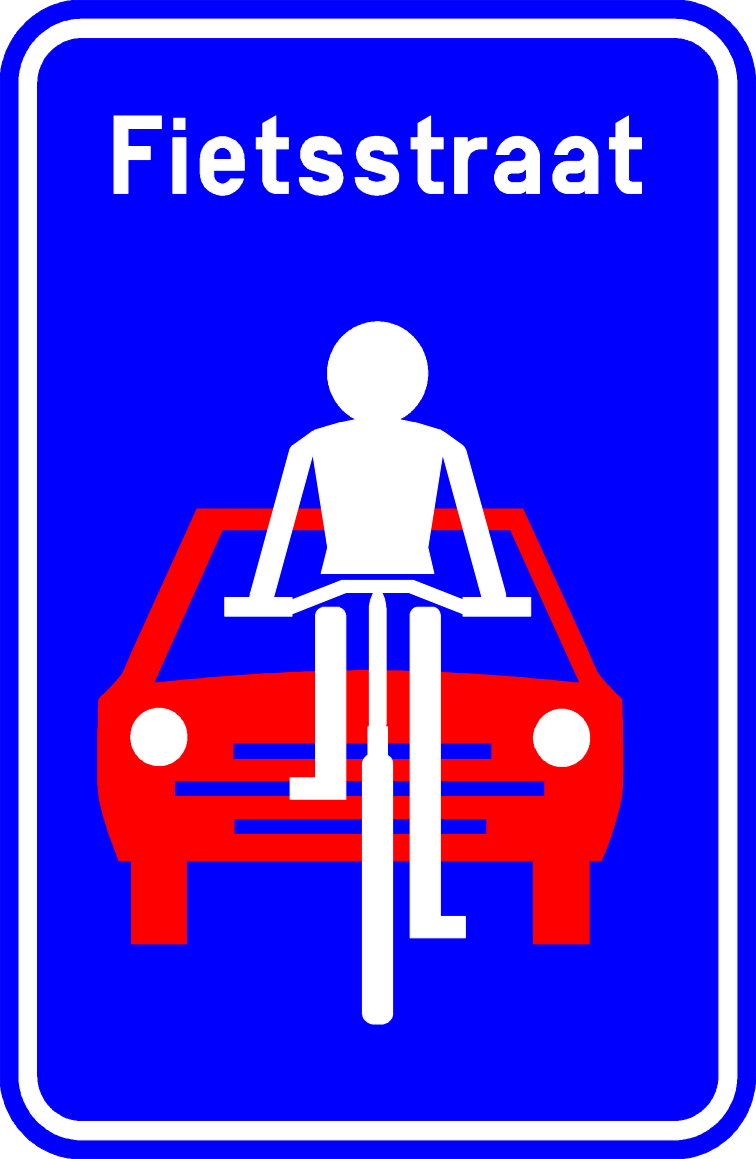
F111 — start of a bike street
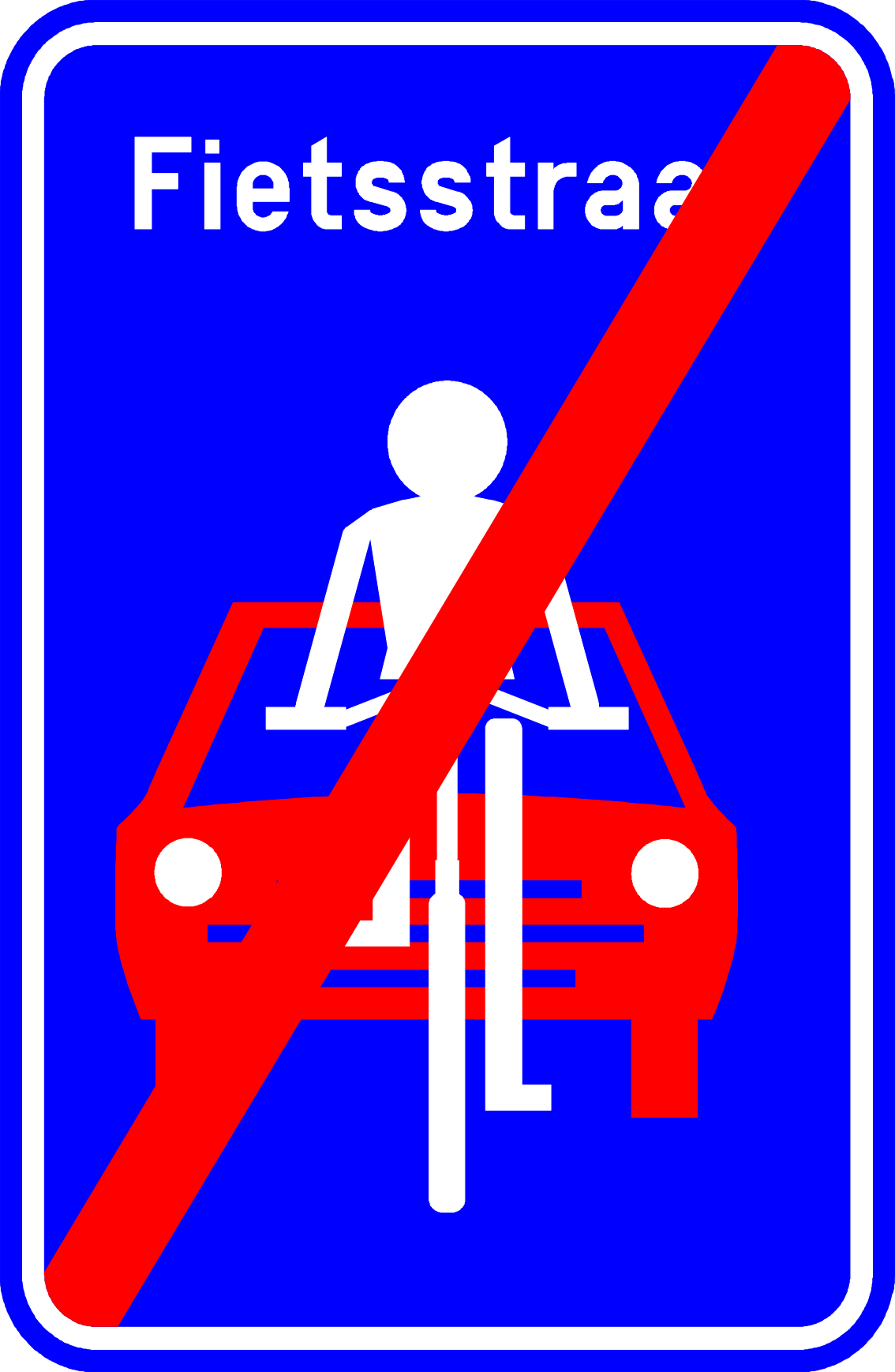
F113 — end of a bike street
A bike zone starts at a 'begin zone' sign and ends at an 'end zone' sign. Inside it, cyclists and speed pedelecs may use the full width of the roadway — or, on a two-way road, must keep to the right half. Motor vehicles may still enter, but, just as in a bike street, may not overtake a cyclist, and the same 30 km/h limit applies.
Cyclists and red lights: signs B22 and B23
At some traffic-light junctions, an additional sign lets cyclists proceed through a red or orange light in one specific direction: B22 allows cyclists to turn right, and B23 allows them to go straight ahead. Neither sign gives cyclists priority — they must still give way to other traffic and to pedestrians, and may only proceed when it is safe.
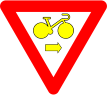
B22 — cyclists may turn right on red
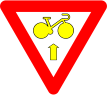
B23 — cyclists may go straight ahead on red
Other vulnerable road users
A person using a wheelchair or a mobility scooter at walking pace is treated as a pedestrian and has the same priority. A person walking while leading an animal — such as a horse or a dog on a lead — by hand is also legally a pedestrian, unlike someone actually riding the animal. Riders and people leading animals still require extra room and patience — never rev your engine, sound your horn, or pass closely near them. Around schools, playgrounds and residential streets, always be ready for a child to step out unexpectedly.
Chapter quiz
Check what you remember. Questions and answer order are shuffled every attempt, and you'll have 20 seconds to answer each one.