Chapter 1
The Public Road & Where Traffic Rules Apply
What legally counts as a public road in Belgium, the parts a road is made of, the keep-right rule, and the default speed limits in each region.
What legally counts as a public road?
A public road covers far more than paved city streets: any bridge, tunnel, square, motorway, or even an unsurfaced track counts too, as long as the public can genuinely come and go there — with every type of vehicle, or only some — without first needing a reason or someone's permission.
- This includes people on foot, and anyone leading a pack animal, driving a horse-drawn cart, or moving livestock along — they too have a right to use most public roads or sections of them.
- Nobody can demand that you explain your reason for being on a public road.
Public areas and private property
A public area is a different, narrower category — think of a supermarket car park or the forecourt of a fuel station. The public can enter, but only visitors who actually have a reason to be there, not anyone passing by for no purpose.
Land that isn't open to the public at all — a haulage yard, or the enclosed circuit where a driving school runs its lessons, for instance — stays private property throughout. Entering it to drive requires the owner's specific consent or a permit, and any road carrying a 'private property' sign follows this same rule: it is not a public road, whatever it may look like.
Where does the highway code apply?
Only on the public road does the highway code carry the force of law — a violation there earns you a fine. That doesn't mean anything goes elsewhere, though: certain serious matters follow you everywhere. Drink-driving, causing an injury in a crash, or driving without holding a valid licence can still be fined or prosecuted no matter where they happen.
The parts a public road is made of
- Carriageway: the hardened surface built to carry vehicle traffic — everything from ordinary cars and buses to mopeds and farm machinery.
- Cycle track: set aside for bicycles — and, only where no such track exists, for class A mopeds too.
- Verge and raised verge: the shoulder running alongside the carriageway, not generally intended for driving or parking on.
- Central reservation: the strip that keeps two carriageways apart, as you'd find running down the middle of a motorway.
- Pavement (footpath): set aside exclusively for people on foot.
Keep right on the carriageway
Belgium drives on the right. That means keeping your vehicle toward the right-hand side of the carriageway whenever it's reasonably possible to do so — pulling into the middle or over toward the left without good cause is a punishable traffic violation.
Correct — keep right
Not allowed without reason
There's one key exception: once a road visibly splits into two or more distinct carriageways — separated, say, by a raised central strip, a stretch of ground vehicles can't cross, or simply a change in height — you're not permitted to cross into the carriageway on your left. That only changes if a police officer waves you across, or a sign specifically instructs otherwise.
Along some carriageways you'll notice a continuous white line running near the edge. Don't read anything into it beyond what it literally shows: where the carriageway stops. On its own, it neither bans nor requires any particular action.
Default speed limits (unless a sign says otherwise)
A posted speed sign always overrides the defaults below. Where there is no sign, these general limits apply:

C43 — maximum speed 50 km/h (any number can appear on this sign)

F1a — start of a built-up area

F3a — end of a built-up area
- Built-up area (between the F1a and F3a signs): 50 km/h everywhere in Belgium.
- Outside a built-up area, on an ordinary road: 70 km/h in Flanders, 90 km/h in Wallonia.
- Brussels-Capital Region: the whole region has defaulted to 30 km/h ('Ville 30') since 1 January 2021 — only a few structural roads are signposted 50 or 70 km/h.
- Motorway: 120 km/h, from the F5 sign to the F7 sign.

F5 — start of a motorway

F7 — end of a motorway
Speed zones and special places
Entering a village or town, you might also spot a place-name sign on an orange panel with a red border. Don't confuse it with a speed-zone sign — it exists purely to mark the municipal boundary and carries no weight in traffic law at all.
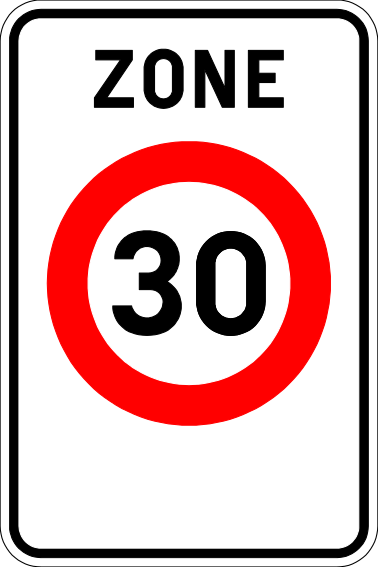
F4a — start of a zone 30
More broadly, a 'zone' means a stretch of one or more public roads bookended by a 'Start Zone' sign at one end and an 'End Zone' sign at the other — a zone 30 being the everyday example. Whatever that entry sign requires stays in force for the entire stretch, around the clock, right up until you cross the exit sign. Where the sign itself is an electronic display, it only carries legal weight for as long as it's actually switched on and showing.
Residential areas ('woonerf')
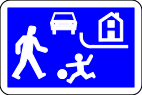
F12a — start of a residential area
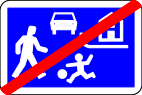
F12b — end of a residential area
Inside a residential zone ('woonerf'), living space takes priority over passing traffic. People on foot are entitled to use the road's full width, and children may play there too — provided they're not creating an unnecessary obstruction. Speed is capped at 20 km/h, and parking is allowed only inside the areas laid out and marked for it, on either side of the street.
20 km/h — pedestrians may use the full width of the road
Parking only in marked bays
Play streets and school streets
A play street ('speelstraat') hands the entire road width over to children for a set period. The only vehicles still permitted through are those belonging to residents of that street, garages with direct access there, and priority vehicles — and even they're limited to walking pace.
Twice each school day — once as classes start, once as they end — a school street ('schoolstraat') shuts its doors to motor traffic to keep the area around the school calmer. A handful of road users can still pass: pedestrians, cyclists, people who live or garage a vehicle there, priority vehicles, and anyone holding a specific permit. All of them are restricted to walking pace, must yield to pedestrians and cyclists, and can never put them at risk or in their way. Signs combined in this manner can also mark out a broader 'school environment' surrounding the routes leading to a school.
Speed humps
A speed hump is a deliberately raised stretch of road surface, built purely to force traffic to slow down. An A14 warning sign gives drivers roughly 150 metres' notice it's coming, and the F87 sign marks the hump itself. Wherever one of these signs applies, or the hump sits at a junction, or it falls inside a zone 30, the speed limit there drops to 30 km/h. Passing another vehicle on the left is banned on a speed hump in every other case — the single carve-out, added 1 April 2023, is that overtaking a cyclist there is allowed.

F87 — speed hump indicator, marking the speed limit of 30 km/h
A14 warns about 150 m ahead
F87 marks the hump itself: 30 km/h
Overtaking on the left is forbidden on a speed hump — except a cyclist, allowed since 1 April 2023.
Driving on a provisional licence
A provisional (learner's) licence does not allow you to drive on the public road during these hours:
22:00 – 06:00 — no driving on a provisional licence
Friday, Saturday & Sunday nights, and the eve/evening of a public holiday
- Friday night 22:00 to Saturday morning 06:00
- Saturday night 22:00 to Sunday morning 06:00
- Sunday night 22:00 to Monday morning 06:00
- The night before a public holiday, 22:00 to 06:00 the next morning
- The evening of a public holiday, 22:00 to 06:00 the next morning
Holding the steering wheel
Grip the wheel with both hands, roughly at the 'ten-to-two' or 'quarter-to-three' positions on a clock face, keeping your arms loosely bent rather than locked straight. That posture leaves room to nudge the wheel left or right in small corrections while your hands stay exactly where they are.
Medically unfit to drive
Should a doctor decide you're not fit to drive, physically or mentally, the law gives you four working days to surrender your licence to your municipal authority. It's returned to you the moment a doctor signs off that you're fit to drive once more.
Chapter quiz
Check what you remember. Questions and answer order are shuffled every attempt, and you'll have 20 seconds to answer each one.