Chapter 3
Road Markings & Lanes
What white lines on the carriageway mean, when you may cross them to overtake, how zip merging works, and the rules for bus lanes.
White, or temporary orange
Belgian road markings default to white. Wherever roadworks are underway, crews paint temporary orange lines over or alongside them instead. Whenever the two colours appear together, orange always wins — that instruction stands even if following it means straying onto the hard shoulder or crossing over the old white paint.
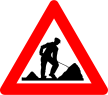
A31 — warning: roadworks ahead
Around larger roadworks you may also see extra blue information signs guiding you through the temporary layout: a temporary lane diversion, a temporary crossover onto the verge, a temporary lane closure, or two-way traffic temporarily allowed on a road that is normally one-way.

F79 — advance sign: temporary lane closure ahead

F81 — advance sign: temporary lane diversion ahead

F83 — advance sign: temporary crossover onto the verge

F85 — advance sign: two-way traffic temporarily on a normally one-way road
Meeting (crossing) oncoming traffic
'Crossing' is the technical term for passing a vehicle coming toward you from the opposite direction. Position yourself as close to the right edge as the road genuinely allows — pick the rightmost lane if there's more than one — so the gap opens up on the oncoming driver's right-hand side. A road too narrow for comfort still gives you an option: easing onto a levelled verge, provided you leave the other driver a fair amount of room to work with.
That strip beyond a solid white edge line exists for stopping and parking, not for making room during a crossing manoeuvre — it's off-limits for that. A cycle track is off-limits too, and for a different reason entirely: it simply isn't part of the carriageway. A painted 'suggestion lane' without official markings sits in a different legal category altogether — it counts as carriageway, which means a brief detour into it to pass safely is perfectly fine.
Overtaking: broken line vs. continuous line
A broken white line running down the middle of the road is your green light to cross it and overtake a vehicle ahead of you that's holding a pace below the speed limit — as long as no sign is telling you otherwise. Once that line turns continuous, crossing it to overtake is off the table entirely, however slow the traffic in front is dragging.
Broken line — overtaking allowed
Continuous line — overtaking forbidden
Two lines running side by side — one broken, one continuous — call for a bit more attention. Whether you're cleared to cross depends entirely on which line sits on your side: cross only if it's the broken one. Once you've cleared the other vehicle, the continuous line on the way back leaves no choice — you cross back over it to settle into your lane.
Arrows painted on the road
Approach a junction and you'll often find arrows stencilled straight onto the lane itself. Don't mistake them for decoration — they're full road markings with binding force, spelling out exactly where that lane will take you. Roads set up this way usually back the paint up with a blue information sign nearby, repeating the same lane layout for anyone who missed it on the ground.

F13 — advance sign showing which lane to take for each direction
Traffic displacement areas
Watch for a patch of tightly spaced diagonal white hatching, laid out as a triangle or a long wedge across or beside part of the carriageway — Belgian road law calls this a traffic displacement area (verdrijvingsvlak). It typically marks the spot where a lane is about to split off or merge in. Functionally, it counts as unusable ground: no driving across it, no waiting on it, no parking in it, exactly as if it were kerb rather than road.
Traffic displacement area — do not drive, wait, or park here
Zip merging when a lane ends

F97 — a lane ahead is closing
Traffic crawling because a lane (or several) has shut down — roadworks, a stalled vehicle, a crash scene, whatever the cause — triggers a strict rule: stay put in your own lane all the way to where the tarmac actually runs out, then slot in one car at a time with whoever's in the lane that keeps going. Occasionally both sides pinch shut simultaneously; when that happens, cars take turns yielding, right-hand vehicle going first, left-hand vehicle following.
Bus lanes

F17 — bus lane
Spot a bus lane by its broad, widely spaced broken white stripes (sometimes a checkerboard pattern instead) alongside an F17 sign — the giveaway that it's set aside for scheduled public transport. Driving in it or parking there isn't allowed, nor is pulling over to drop off or pick up a passenger. The carve-outs are narrow: crossing it in the final stretch before a junction to turn, swinging around an obstacle, or cutting across to a driveway, parking area, or property on the far side.
Legally, a bus lane sits outside the carriageway altogether. You'll occasionally find a small extra panel mounted below the F17 sign that opens the lane up to one more group — a bicycle symbol on that panel, for instance, means cyclists are welcome to ride there too. Moped riders and motorcyclists get the same kind of carve-out through their own matching panels.
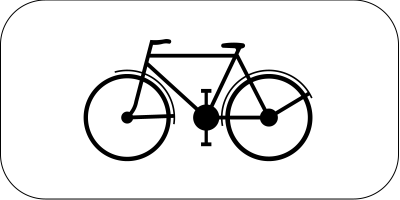
M1 — 'cyclists' (used under the F17 bus lane sign to admit cyclists too)
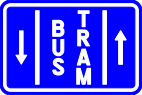
F18 — special track reserved for trams and buses
F18 marks a different thing from an F17 bus lane: a special track physically set apart from the carriageway for trams and buses, shown by road markings such as one or two solid white lines or a checkered pattern of white squares. It is not part of the carriageway, so other vehicles may only cross it briefly — to reach or leave a parking space, to enter or exit a driveway, or at a junction.
Chapter quiz
Check what you remember. Questions and answer order are shuffled every attempt, and you'll have 20 seconds to answer each one.